Sunday, December 16, 2007

Harlan County, USA

Harlan County, USA is a kaleidoscopic account of a recently unionized group of miners’ struggle for a new contract with better wages and benefits. In under two hours Kopple somehow manages to cover not only the day-to-day life on the striking miners’ picket lines, but also the gendered complexities of the strike effort, the harsh facts of everyday life in an impoverished mining town, the cultural resources (notably music) locals employ for emotional support, the violent struggles in “bloody Harlan” during the 1930s, and conflicts within the United Mine Workers Union (UMWA).

In many ways the film is an extended sorrow song, providing an unflinching look at physical decay, death, and the necessity and ubiquity of suffering. Whether it’s black lung destroying miners’ ability to breathe, the atrocious living conditions for most miners, or the seeming necessity of one miner’s murder for the coal company to finally agree to a new contract, we witness a group of dignified men, women and children whose lives are filled with troubles. There are joyous moments, laughter, and the consolations of family and friends, but the tenor of life in this community is best captured halfway through the movie when Kopple films a daughter and her father singing the lament “O, Death” with its stark plea for death to “spare me over til another year.”

The young miner’s murder near the end of the movie marks the end of an increasingly violent struggle between the miners and the “gun thugs” hired by the company to break the strike. The escalation of violence – fists, bats, guns – and the necessity of this escalation for justice to be achieved are central themes of the film. (Kopple, who makes no effort to hide her sympathies for the striking miners, is at one point physically attacked by strikebreakers.) Individuals counseling non-violence are openly mocked by other miners. Responding to the use of handguns and machineguns by Basil Collins and his “gun thugs,” miners begin showing up to the picket-line with guns of their own. After one meeting by the women in the community, Lois Scott, the most vocal woman amongst many strong female activists, reaches down her shirt to withdraw and show to her compatriots a newly purchased handgun. (Why burn your bra when you can use it as a holster?) In a perceptive accompanying essay to the Criterion Collection DVD which places the film in the broader context of 1970s documentaries, Paul Arthur remarks that Scott “embodies the film’s most troubling, and enduring, question: how to fight against corporate intimidation without jeopardizing the goals or moral capital of the union cause.” Given the gross inequalities of power and prestige between the miners and the mining company (Duke Power), it is hard to believe that the company would have ever signed the contract if the miners had not become more willing to use violence as a regrettable means to a just end.

Wednesday, December 12, 2007


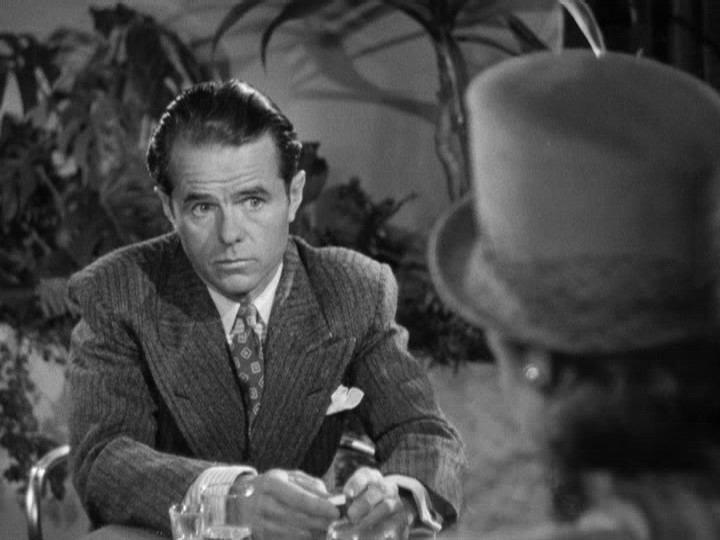
Elisha Cook Jr’s middle-age double sat in front of me on the T today. I love Cook as a desperately grasping (and in way over his head) husband in Kubrick’s The Killing and as the honorable tough guy who falls for another (minor league) femme fatale in Hawks’ The Big Sleep.

Thursday, December 6, 2007

Bike Helmets and Radiohead -- Hurrah!

Pimp C on There Stands

So I don't know diddley about hip-hop. Pretty much everything I do know comes through my ex. (white man dancing to Edan y'all?) But this excellent blog, which I've been going to recently, has a strong embedded youtube clip from Pimp C -- someone I just found out about because he's another dead black man with a reputation in the musicworld. When I hear something this good -- it glides confidently -- I know how little I know.

Wednesday, December 5, 2007

Today's New York Times has a curious op-ed by Kenneth Woodward entitled "Mitt Romney is No Jack Kennedy." The title is misleading, for the piece isn't so much about Romney not being as "good" a human being or politician as Kennedy (Lloyd Bentsen's swipe at ol' Danny Boy Quayle), as much as it's about their respective religious and media environments. In short, Woodward argues that Kennedy faced a much more united and visible attack on his Catholicism-- led by such notables as Norman Vincent Peale and L. Nelson Bell (editor of Christianity Today) -- while Romney, though definitely hobbled politically by his Mormonism, is not encountering the same concerted criticism. The interesting twist Woodward provides is asserting that Romney is worse off because of this.

Using each candidate's religion-specific speeches – Kennedy's famous 1960 address in Houston to a group of Protestant ministers and Romney's meeting with Republicans in Dallas tomorrow – as test cases, Woodward writes:

Mr. Romney, in contrast [to Kennedy], faces no organized religious opposition he can allude to, no anti-Mormon campaign he can shame — as Kennedy adroitly did — for blatant religious bigotry

and:

Kennedy engaged a live audience of doubters and bearded lions in their own den. It was high noon drama. Mr. Romney will speak in protected Republican surroundings, unable to engage a pair of adversarial eyes or read a single hostile face.

I might ask how much Kennedy’s speech accomplished. Perhaps he was able to convince some Protestant elites of his respect for the separation of church and state, but did his command performance swing a significant number of Protestant voters into his camp?

I also wonder if Romney’s Mormonism is as much of a drag on his campaign as Kennedy’s Catholicism was on his? Woodward offers that many Americans will “accept Romney’s assertion that Mormons are [unorthodox] Christians.” And given that Christian conservatives have come to overwhelmingly support Republican Party candidates, it seems reasonable to think that they would not vote for a Democrat just because Mitt is Mormon.

But it’s that “unable” in Woodward’s last sentence which has me truly puzzled. Does Woodward actually believe that Romney (or any other contemporary politician) would welcome the opportunity to appear before a united front of religious (or political) critics and attempt to persuade them that he is to be trusted regardless of his religious beliefs? In this day and age of staged-managed electioneering I have my doubts.

Thursday, November 29, 2007


Somehow cat-hoarding and cat ladies came up at work today. I probably got the conversation going. I tried to remember a recent news article about a very large number of (feral?) cats living on a beach and being fed by some activists. Trying to find this article on the internet, I came across a few other rather interesting stories about cat-hoarding and cat ladies. But before we get to those fascinating tidbits, I have a confession to make. For a certain period of my pre-teen years I thought it would be truly magnificent to have a house full of cats. Say, 50 or more. This dream of mine evolved into the idea of having a room in a house devoted to the cats. The cat room would be large with a glass wall for observation of the felines. That moment in time, thankfully, has passed. I can unequivocally state that I no longer want a cat room. Nor do I desire to have, say, 50 cats. However, I still think that having about 10 cats would be quite pleasant. And now that I've opened myself up to ridicule, I can move on to linking to a few cat-hoarding and cat ladies stories.

First, the Moscow cat lady. I suggest turning the volume way up on this one. Between the cats meowing and their feet hitting the ground, you get a nice noise-collage.

Second, the Wikipedia entry on Animal Hoarding. Read and learn, people. You just might have the mental illness.

Third, while searching for the feral cat story mentioned above, I found this blog. (Go to August 23, 2007 for the cat-hoarding post.) The author examines daily life – wedgies, Don Imus, and cat hoarding, etc. – through the prism of Christian scripture. Every moment is a teaching moment.

Tuesday, November 27, 2007

FDR and Bob

Tonight I drank a few beers and had dinner face to face with Franklin Delano Roosevelt. He sat across the bar from me. There was no stopping him: hanging there on the wall like he has for millions of other Americans, his calm, self-assured, elemental presence greeted me every time I looked his way. Another three letter man -- JFK -- surrounded him. (How many three letter men do we have?) In this corner of Boston, JFK may not be gainsaid. He invented the wheel as far as these folks are concerned. Or at least he didn’t back down when that shoe-banging Russian tried to get smart in our backyard. But while FDR was in front of me and JFK was all around me, middle-aged versions of Moe, Larry, and Curly sat next to me. On my right to be exact. First to my right was a self-described “vengeful” man. After 9-11, specifically on 9-12, he would have bombed Saudi Arabia and Iraq until nothing existed but the battered land. The man to his right thought this a fine idea. But being the pragmatist of the bunch, he thought it far more feasible to just take over the oil fields of these two countries, and then let us have gas for “6 cents a gallon,” and drive as much as we want. I never heard from Curly. But Mr. Pragmatic did call him a Francophile and said “what’s next, you’re going to tell me you want us to have a 35 hour work week?” It was during this meeting of the minds that a harmonica made its appearance. Not for them, but for me. Straining out of the speakers, an early Bob tune played. And all I could hear of it was his harmonica. The sound was quite low -- just enough to provide a very vague background to the poli. sci. 101 class at the bar. But when Bob and his harmonica arrived there was no mistaking that high-pitched, insistent sound. And for a brief moment I was transported back to the 60s. I had a dim understanding of what it must have felt like to think Dylan was Truth. Specifically, the dissonant chord Dylan must have struck and how that chord united so many around a shared rejection of a racist, chauvinistic society. I can’t say (or maybe I’m just incapable of saying) more than this right now. I sat there incredulous as three men self-righteously destroyed the world. (Who proudly says “you know I’m a vengeful motherfucker”?) I wanted to laugh at the inanity of the pronouncements, but I looked over at Franklin and all I could think about was the utter lack of dignity.

Sunday, November 25, 2007

Since moving to Boston in 1995, I’ve enjoyed the company of friends during Thanksgiving. This year was different. While I did receive an invitation to share the Thanksgiving day meal with the Sorella’s gang (I probably go there 100 days in the year, twice a week, every week: they know me). I decided I would go it alone this time.

The holiday break was a series of encounters with strangers, a friend from the past, and a rabbit.

First, the rabbit. A rabbit in JP. (I should write the children’s book, with the rabbit modeled, of course, on the trickster Max.) Walking down the sidewalk of Pershing Road, I had the hushed pleasure of meeting this small, calm creature. Seeing the little bun – four feet away – I went still and focused my gaze upon it. Thankfully, it did not move. Rain had come and gone, leaving the streets oil-slick and adding peculiar weight to the fallen leaves. Pershing is not a well-lit street, but the light we shared added to the quiet reverence of the moment. Alone together, we watched each other for a minute. Taking a chance on having him run, I offered a small Barry Lopez bow of acknowledgment and gratefulness. He didn’t move, so we continued our meeting. Like the local squirrels, he is probably so used to humans (and humans feeding him) that the quick dart for safety response to us has been at least partially supplemented by a wary acceptance. I would guess that we stared intently at one another for 3-4 minutes. And then, just like the end to a casual conversation with a friend, he said goodbye and took a slow-hop to the edge of the sidewalk. But he didn’t leave. He stood there for another minute, watching me watch him. I wondered where he lived. Where was he going on this damp night? Where did he sleep? Whom was he returning to? So many worlds, so close to me. But he has his life and I have mine, so off he went with another easy hop.

On Thanksgiving day I decided to make biscuits from scratch. Not having the ingredients at hand, I walked down to stop&shop. On the way there I thought about my friend Bubba. When I worked at Gutman Library in the late 90s I would see him on the corner of Brattle and Church, standing outside the grocery store that once occupied the spot. Bubba would stare straight ahead. He had small eyes and usually kept a few days growth of beard. Close to his body, he would extend his cupped-hand. He never asked for money. I don’t recall our first conversation, but I do recall that we laughed from the start. We shook hands that day. His life was not an easy one, but he did not complain – even when times took a turn for the worse, usually in winter. After a few meetings, the handshakes became hugs. He always asked about my family. We would stand on the corner and talk about Boston, Cambridge, sports, life. I have not seen him in at least 3 years. Thinking of Bubba, I discovered that Stop&Shop was closed. I headed back home. No biscuits for me. But on the way back I met Matt. He asked me if I knew where the Green Street T stop was located. Right away I knew this man was thoroughly confused. While not actively drunk at the time, he had pickled his brain over the years with booze. He was not fully in control of his body. We walked slowly. Over the course of our walk he told me again and again that he was in jp to pick-up a check from his workplace, but that it was closed that day. Recently he had celebrated his 45th birthday. “I was 44, but now I’m 45.” He looked 60. But 8 years ago he had a wife and 2 kids. When he told me this I was stunned. It was genuinely hard to imagine Matt as anything more than a homeless man with a severe alcohol problem. I wondered where his family was. Did he even know how to contact them? He never asked for money. He just wanted to get to Green Street without passing the cop station. He commented on his clean clothes and new shoes. The shoes were a little tight for his feet, but he was thankful for them. He told me that he was a “nice guy – an Irish Catholic Alcoholic.” And like so many other folks in this country he thinks the “younger” Bush is horrible. We walked and I listened. On the corner of Centre and Moraine we split. I failed him (and Bubba) that Thanksgiving day, for God knows that even from there he was going to have a helluva hard time finding the T stop. And I had nothing else to do that day. I hope those new shoes found him a warm spot these last few cold nights.

I’ve started going to Galway House. I went there on Friday night for the Lakers-Celtics game. About halfway through the game, John came in. He was a little toasted and he wanted to talk. The man to my left, Timmy, and the man to my right (I forget his name, but he has run the TV repair shop next to Ferris Wheels for 35 years. He was drinking Hennessy on the rocks with a splash of Crème de Menthe) knew him. John had apparently told Timmy that his middle initial, K, stood for Kareem. He did not alter this story over the next 2 hours. What he did do was provide verbal punctuation to just about every sentence he uttered. I asked him if he knew how to make a manhattan. This provided him the opportunity to tell a very long story about his grandmother, taking away her driver’s license, her request for a manhattan, his job, the mayor of Boston, and a few other items. Throughout this story and throughout everything else he said, John would say “bang!” “I walked out of my office – Bang – and answered the phone – Bang – I had to go meet my grandmother and tell the mayor I had to leave the meeting – Bang.” Sometimes the “bangs” came in twos or threes. We shook hands 4 times before I left. Each time he took off his glove. (As is the usual custom at Galway House, you get up to leave, put on your coat, and then drink another beer and talk for 20 more minutes.) And the Celtics got a sweet, casual win over the Lakers.

On Saturday night I went to see Gone Baby Gone. At the Stonybook T stop, I was randomly re-united with an old friend from my Div. School days. Her first name is Kerry. I have forgotten her last name. She worked at the Div. School Library in the mid to late 90s. She helped me out on a particularly horrible day in 1997, and I will always be thankful for her kindness. She gave me a great hug. We talked and waited for the train. I remembered her dog Gus. Gus had wonderful tone; our shared friend Michael Montague used Gus as his personal grand piano. As Kerry said, Gus was “a remarkable instrument.” As I got up to depart at the Chinatown stop, Kerry stood up and gave me another long hug. I hope the next week with her girlfriend’s mother in town goes quickly.

And that, along with singing to Bob Marley while pretty goosed and talking to Arturo about life and love, was my Thanksgiving break.

Monday, November 19, 2007

Here's an article from the New York Times about Sandra Day O'Connor's husband's romance with another woman in a nursing home. Both her husband and his new love have Alzheimer's.

Wednesday, November 14, 2007

This morning, riding the T, I read this line from the chapter "Seeing" in Annie Dillards's Pilgrim at Tinker Creek:

I cannot cause light; the most I can do is try to put myself in the path of its beam.

Dillard writes about reading Space and Sight by Marius von Senden. The book details the case histories of individuals, blinded since birth by cataracts, who were given sight by the first surgeons to discover how to safely perform cataract surgery. Their first awakenings to the world of light were radically divergent. Some, overwhelmed by the gulf between their blind and sighted experiences and understanding of the world, wanted to return to blindness. The world of sight was a horrible subversion of spatial and, more importantly, self knowledge. Of those who embraced their new world, a common experience was the coloristic flatness of space and shape. An example: one woman stands in front of a tree, touches it, and proclaims it is "the tree with the lights in it." With great reason, Dillard wishes these men and women and children had been given the materials to paint. She also, with great reason, yearns to every now and then catch a glimpse of this flat world.

Tuesday, November 13, 2007


For the first hour of Takeshi Kitano’s Fireworks I felt that I’d never seen a film with so much respect for an audience’s intelligence. Kitano’s absolute command of elliptical editing is quite striking. I was reminded of Soderbergh’s The Limey (still his best movie?). There are those moments when you feel a director is so vitally in touch with his vision of what film (and a particular film) should be; Fireworks is one of those moments.

The silent scene between Nishi and his dying wife Miyuki should be required viewing for any director wishing to say anything about intimacy, the quiet solace of marriage, and the dignity of caring for another person. The epitome of anti-sentimentalism.

Monday, November 12, 2007

Michael Clayton


After Michael Clayton (George Clooney) finds out that his friend and colleague Arthur Edens (Tom Wilkinson) has died he goes to a bar to console and be consoled with other friends of Arthur. Simmering with unease and bewilderment at Arthur’s suicide, Clayton is told something about Arthur which makes him think his death might not have been a suicide. What is most striking about the final shot of this scene is the particular use the director (Tony Gilroy) makes of a visual trope used throughout the movie: bright but smudged/hazy lights crowding the screen, enveloping Clooney. But in this particular instance the director pulls off a bravura halo effect, managing to make the lights appear to share the same spatial plane as Clooney’s face. He lingers on the shot for at least two reasons: it’s gorgeous and it (along with Clooney’s dumbstruck questioning look) signifies the dim awareness our protagonist is beginning to have of the evil around him.

Tilda Swinton’s Karen Crowder can’t look at a mirror without wanting to vomit. Her moneymaker -- the ability to make words handle the weight of nothingness and deceit -- has finally cashed out, and her desperation and disgust lash her as she battles her sorry mirror-image presentation of self in everyday life. The power of positive thinking routine of finding your id plus ego-ideal self in a warm-up speech before a private mirror -- ah, the luxurious safe haven of a closed door -- isn’t working anymore. Unfortunately, the movie can’t quite make enough room for her character. We never know if she, like Arthur and Clayton, has become aware of how deeply she is involved in a nefarious enterprise, or if she is simply suffering under the demands of keeping up a pretense of power and justness for public consumption. A shame, for she’s Clooney’s double, and a more drawn out meeting between the two characters would have added thematic depth to the film.

Swinton furtively using a small, plastic trashbag as a glove to handle some items she shouldn’t have her hands on is hilarious. It points to her desperation, but it is also a brilliant dig at the pathetic backroom trickery of corporations. (Wearing the plastic bag also links her to Clayton: they are both "janitors.")

Sunday, November 4, 2007

off the blue highway


I'm reading William Least Heat Moon's wonderful Blue Highways. Perhaps the most fascinating aspect of the book is Moon's attention to and exposition of the particular features of a given space. As he drives along the blue highways, or walks out into the desert, or sits beside a stream, the reader is treated to a cornucopia of information about the flora and fauna of a specific area. About halfway through his journey he comments on a frequent assertion made about the Texas desert plains: there's nothing out there. Moon pulls over to the side of the road and then walks into the desert to test the hypothesis. He ends up counting in no time at all 30 signs of life, including earth, sky, and wind. About a week ago I reconnected with my friend Emil. We both talked about the joys of stopping at a random spot on a mountain hike and just being still and listening to and looking for what that place at that time was being. Reveling in the immensity of all that is not human, all that does not need us. It is a real pleasure to read an author with such an observant eye and solid knowledge of the natural world; someone who through those gifts and the painstaking craft of writing makes that world more visible.

Wednesday, September 12, 2007

Wouldn't It Be Nice...


From a review in the Financial Times of a recent Brian Wilson concert in London at the Royal Festival Hall:

There were more between-song comments than three years ago, most of them charmingly off-beam. “Imagine if there was no one here,” he wondered aloud at one point. “It’d be empty. We’d be playing to an empty audience.” Occasionally a smile bobbed on to his features. At other times he looked lost in reverie, as if concentrating on a problem whose solution was in danger of eluding him.

If there is a more concise summation of Wilson's concert-in-my-mind way of seeing (being-in) the world than his quote from above, I'd like to read (not "hear," for certainly Wilson has provided the musical soundtrack to his quote) it.

Juxtapositions


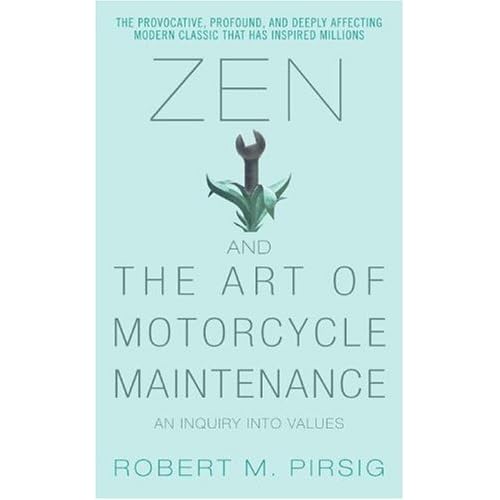
Today, while doing a bit of stacks maintenance work, I came across a curious, at least to me, juxtaposition of books. From left to right I found: The First John Ford, Zen and the Art of Motorcycle Maintenance, and John D. Rockefeller's Secret Weapon. Having not read Pirsig's book, I can't say for sure that it has nothing in common with either of those two titans of industry books buttressing it, but I still have to wonder about the original cataloging decision to place Pirsig's mid-seventies veiled-autobiography within the non-fiction CT (Library of Congress' Biography subclass of Auxiliary Sciences of History) classification.

Correction: The book to the left of Pirsig's on the shelf is The First Henry Ford -- not John Ford. At least on the level of title John Ford's The Quiet Man would link up vaguely, very vaguely, to the usual public perception of Zen.

Friday, August 3, 2007

The so-called new Big Three in Celtic Green


With the arrival of Kevin Garnett in Boston a host of commentators -- local and nationwide -- think the Celtics have a serious chance to make a run at the East championship. While I am pleased about Garnett wearing Celtic Green, I do think the team is short 2 or 3 quality players. Rajon Rondo is a solid defensive player who can drive and dish, but he has no outside shot to speak of. There are some other promising, young players on the team, but they are that: young and promising, no more. The Boston Globe's Bob Ryan hits the nail squarely on the head with his analysis of the difference between the new big three and the great Big Three of Bird, Parrish, and McHale.

Thursday, July 26, 2007

to and from houghton


I just returned from a weekend journey to Houghton, Michigan, located in the Upper Peninsula of Michigan. I went for a wedding. This is the second time I've been to Houghton; both times for weddings. The wedding was held in a park with Lake Superior stretched out at the backdrop. I continue to call Lake Superior an ocean, for with waves like it sometimes has and with a horizon which holds no land, it feels like an ocean to me.

On the way to Houghton, heading up on I-75, my girlfriend Sally and I came across a billboard advertising PoopyCredit.Com. "Stinky Credit? Yes?, try poopycredit.com." Filthy Lucre, indeed. What gets me most is the utter infantilism of the word "poopy." Who does this appeal to? And should they be allowed to vote?

While that particular billboard will sadly remain etched in my brain, I have another image from the trip which I shall cherish: a large, reclining fish smoking a pipe. Yep: smoked whitefish.

Wednesday, July 18, 2007

sidewalk biking


I've just moved to Ann Arbor. I used to live in Boston.

There are plenty of bicycles here. Not as many as there should be, but a start. But they've started with a problem: the vast majority of Ann Arborites (or is it Ann Arboreans? What are the rules for this sort of thing?) ride their bicycles on the sidewalk. You are walking along a sidewalk and lo and behold you find someone cruising down the side of the walk you are using. And I don't understand it. Why are so many people riding their bikes on the sidewalk? My gal sal says that at least folks are riding bikes, and she highlights the fact that so many people are scared of riding in the streets. Moral: we should be thankful for the sidewalk riders, for they are riding bikes and not gas-guzzling. I see her point. But Ann Arbor isn't exactly Grand Central Station, especially in summer. My question: How does this sort of thing get started? How does an entire town come to think that it is okay to ride bicycles on the sidewalk?

Tuesday, July 17, 2007

begin again & Youth


So I was sitting around (unemployed) and thought I'd try to blog again. We shall see how this goes.

I watched Youth of the Beast (dir. Seijun Suzuki, 1963) today. It's a hard-boiled revenge drama, with an-ex cop (Jo) in the anti-hero role. Suzuki starts the film in black and white, at a murder scene. At the end of the scene the camera fixes on a table with a "colored" flower sitting in a glass. Besides ushering in the use of color for the rest of the movie, I wonder if this is a jab by Suzuki at other Japanese directors who were working in black&white: This is Now. Perhaps the most jarring feature of the film is its embrace of non sequitur as a narrative device. Suzuki jump cuts often, showing no concern for narrative continuity. But what I found most enjoyable about the movie was its elaborate mise-en-scene. There is a justly famous scene in which the head of the Nomoto gang whips a whore as an orange-lit sandstorm blows violently in the background. An early scene in which Jo invites himself into the Nomoto gang makes stunning use of volume contrasts, with silence put to hallucinatory effect.